The best snowboard socks are usually thinner than people expect. A snug, mid- or light-cushion merino blend that rises above your boot keeps feet warmer and the board more responsive than a fat wool sock. Below are the socks that consistently rank highest in independent reviews, what each is for, and the complaints riders report most.
Why thick socks make your feet colder
This is the most common mistake on a first trip. Snowboard boots are designed to fit with one thin-to-midweight sock. A heavy sock does three things:
- It squeezes the foot. In a snug boot, extra bulk compresses your foot and restricts circulation. OutdoorGearLab testers sometimes had to swap out a heavyweight sock midday for exactly this reason.
- It holds sweat. Boot fitters point out that a thick sock keeps moisture against your skin, while a thin sock passes it to the liner. Wet feet get cold fast on the lift.
- It hides a fit problem. If your heel only stays put with a thick sock, the boot is too big. Burton notes that excess sock material bunching inside snowboard boots leads to blisters.
So: one pair, no doubling up, and only as much cushion as the boot has room for. Riders with roomy or packed-out boots can go thicker. Darn Tough suggests cushioned midweights for cold-footed riders who spend a lot of time on chairlifts.
Best snowboard socks by type
Darn Tough Function X Midweight: best all-around. 59% merino, 38% nylon, 3% Lycra, OTC height, with targeted cushioning. The Inertia named it the best all-around snowboard sock. Its biggest selling point is Darn Tough’s lifetime guarantee. The complaint: underfoot cushioning gives no arch support, so pair it with a good insole if you need one. Darn Tough’s other socks share a common gripe that OutdoorGearLab noted on the Solstice and Pennant RFL: a snug toe box for wide forefeet.
Darn Tough Pennant RFL and Solstice OTC: thin and nearly indestructible. The Pennant RFL is ultra-lightweight with zero cushion (35% merino). The Solstice is lightweight (45% merino). Both scored 10/10 for durability in OutdoorGearLab testing and are very breathable. Pick them for tight, performance-fit boots or if your feet sweat. They’re less warm than cushioned socks.
Smartwool Targeted Cushion OTC: best fit. OutdoorGearLab’s Editors’ Choice for ski socks and Switchback’s top pick. It’s a lightweight sock with cushioning targeted to high-impact zones, a merino-heavy blend (around 59–66% merino depending on the version), and compression through the leg so it doesn’t slide down. Switchback notes Smartwool’s snugger fit and higher merino content, but Darn Tough wins on durability and warranty: Smartwool offers two years versus Darn Tough’s lifetime guarantee.
Smartwool Zero Cushion: best for tight boots. About 55% merino, no padding, very breathable, dries quickly. It’s ideal for new boots that are still tight. Its weakness is low warmth outside the boot, and ultra-thin socks generally wear out sooner than thicker ones. OutdoorGearLab noted this on Smartwool’s PhD Pro Free.
Smartwool Snowboard Full Cushion: warmest classic. Around 66% merino with full terry padding. The Inertia called it the best heavyweight pick, warm and soft, but it gets heavy when wet. Use it in roomy boots on very cold days, not in a tight fit.
Stance Snow OTC (Boyd Mid, Misty Wool): best style and left/right fit. Stance’s wool snow socks are anatomical left/right designs with Infiknit reinforcement at the heel and toe. Merino content is lower than Smartwool or Darn Tough, for example about 31% on the Boyd Mid and 25% on the Misty Wool, with nylon and polyester making up most of the rest. The Inertia named the Stance Freeton Snow Midweight its best value pick. Expect a bit less warmth per thickness than merino-heavy socks, but bold designs and good shape retention.
Burton Performance Midweight: snowboard-specific cushioning. 53% merino, 45% nylon, 2% Lycra, with targeted cushioning laid out for snowboard boots. Reviewers liked the details but noted minimal shin padding. If you get shin bang from a stiff boot tongue, check where the padding sits before buying. Burton’s Performance Lightweight is the thinner option for riders who run warm.
Dakine Summit: midweight merino blend. An OTC midweight with medium cushioning in the footbed and compression at the instep, ankle and cuff. Retailer listings disagree on the blend (anywhere from 35% to 52% merino), so check the label. It’s a reasonable mid-range choice, but we found no independent long-term review of it.
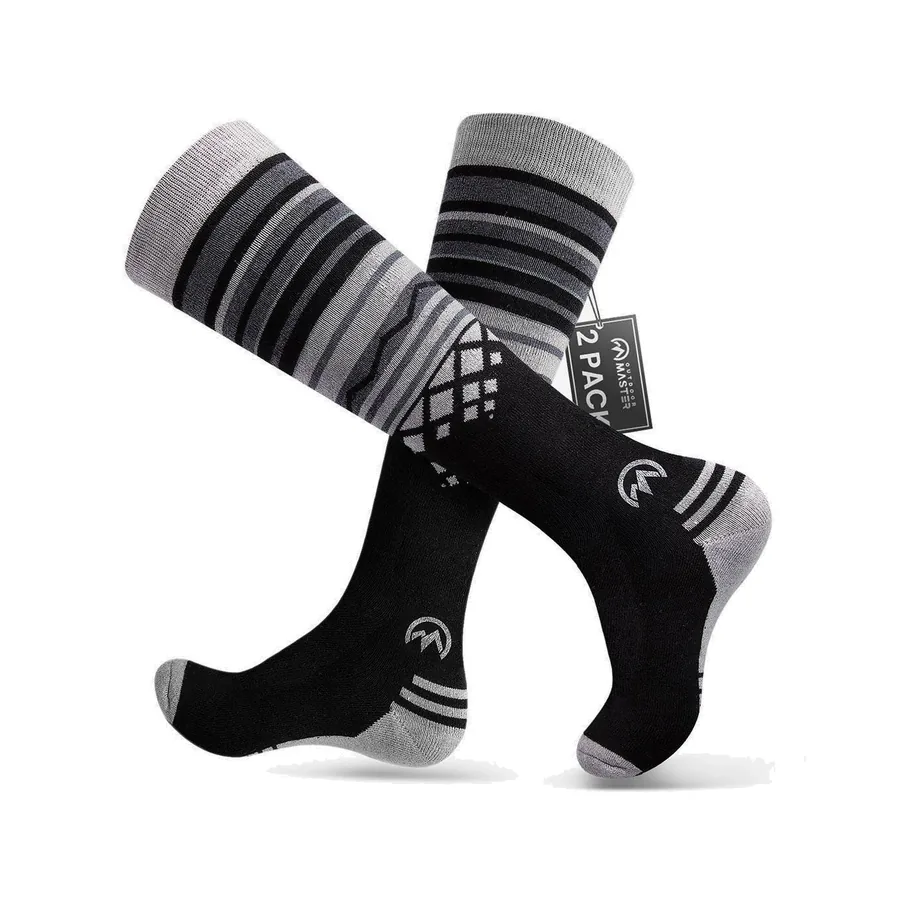
Budget merino socks. Multi-pack merino blends (OutdoorMaster, Hylaea, Minus33 and similar in our ski and snowboard socks) are fine for occasional riders. Watch out for heavy knee-high “thermal” socks sold in multipacks: they’re often too thick for a snug snowboard boot. For durability on a budget, OutdoorGearLab’s Best Buy was the synthetic Fox River Chatter, which also has a lifetime warranty, but it tends to slide down thin calves.
Heated socks
If your feet are cold even in a well-fitted boot (poor circulation, Raynaud’s, very cold resorts), heated socks solve a problem no regular sock can. The Lenz 5.1 uses a clip-on lithium pack at the cuff that you can adjust in an app. Lenz quotes up to about 14 hours on the lowest setting. Across the Lenz range, high heat drops that to roughly 3.5–4.5 hours. Owner reviews mention that the 5.1 fits slightly large. Cheaper sets like Therm-ic list about 6 hours on low and 2.5 hours on high. Heated socks are thicker than a thin ski sock, so try them with your boots.
How to choose: quick checklist
| Your situation | Start with |
|---|---|
| New or tight boots | Ultralight or zero cushion (Smartwool Zero Cushion, Darn Tough Pennant RFL) |
| Most riders, most days | Light or midweight targeted cushion (Darn Tough Function X, Smartwool Targeted Cushion, Burton Performance Midweight) |
| Cold feet and roomy boots | Full cushion (Smartwool Snowboard Full Cushion) or heated socks |
| Sweaty feet, spring riding | Thin synthetic or low-merino blend, plus a spare pair |
| Shin pressure | Sock with a shin pad, and check your snowboard boots fit |
Height: go over-the-calf (OTC). The sock should end well above the boot cuff so there’s no elastic or seam where the boot tongue presses. Keep your base layer bottoms out of the boot, ideally with a 3/4-length cut, so only the sock goes inside.
Size: REI recommends sizing down if you’re between sock sizes. A loose sock bunches under the ball of your foot.
Fit, dry, replace
When you shop for snowboard boots, bring the thin riding sock you plan to use. A boot that only feels secure with a thick sock is the wrong size. Change socks at lunch if your feet sweat. Dry liners overnight according to the maker’s directions, not on a hot radiator. Replace socks when the heel thins out, the cuff stops staying up, or the sock starts bunching. If you’re building a setup from scratch, our beginner snowboard gear guide shows where socks fit alongside boots, base layers and the rest.